

How To Draw Water With Colored Pencils
Everyone's familiar with watercolor paintings, just did you lot know you lot tin can create similar art with pencils? In this guide to watercolor pencils, I'll requite you an overview of this medium and show you lot how to go started.
What are Watercolor Pencils?
Watercolor pencils look just like regular colored pencils. The deviation is that they react to water and can create furnishings like to watercolor paints.
The binding in watercolor pencil pigments is water-soluble. When you lot add h2o, the binding releases more paint, resulting in intense colors.
Traditional colored pencils use an oil or wax-based folder, which allows them to stick to a newspaper's surface and are amend suited for layering and blending.
You tin't blend and layer with watercolor pencils the same style, but you tin attain some interesting effects by adding water.
Watercolor Pencils vs. Paints
So how practise watercolor pencils compare to paints? Are they just watercolors in pencil course?
Not exactly. These are two separate but related media.
Mastering watercolor pencils won't make yous a master painter. And even seasoned painters would need to brush up on techniques if they decided to switch to pencils.
However, watercolor pencils and pigment complement each other well. You lot tin can use pencils to add details to your watercolor painting. Or create a background with paints and draw the principal subject with pencils.
Both media teach you to work with pigments and water.
Watercolor painting is notorious for being the about difficult type of painting. Watercolor pencils can be a style to ease into watercolor painting. You'll learn how water affects pigments, moves paint beyond a page, and blends colors.
Benefits of Watercolor Pencils
You tin sum upwardly the benefits of using watercolor pencils over paints in iii points:
- Control
- Detail
- Convenience
A pencil is easier for most people to command than a brush. That lone makes watercolor pencils less intimidating. They likewise require less water, which is the most unpredictable aspect of watercolor. Having better control over water gives you lot more than control over the pigments on the page.
Pencils also allow yous include more detail. The sharp signal of a watercolor pencil allows you to lay down more visual information than the flexible point of a brush. If you want a particularly crisp line, you don't even have to add water.
Watercolor pencils are also a convenient way to pigment in color. Unlike paints, all you need are the pencils of your choice, a brush, and a small amount of water.
What Materials Do You Need?
- Watercolor pencils
- Paper
- Castor of your selection
- Graphite pencil (optional)
- Masking fluid (optional)
Watercolor Pencils
If you lot're just starting out, choose a basic set of 12 watercolor pencils. For those on a strict budget, or just feeling adventurous, you can get by with only the three main colors: scarlet, yellow, and blueish. Black and white tin can be useful but aren't necessary.
High quality watercolor pencil sets are available for whatever skill range from beginner to professional artist. Let's take a look at a few different options.
Beginner: Derwent Watercolour Pencils
This set of 12 pencils is a not bad way to become started with the medium. They are affordably priced but even so high quality enough that y'all will get the true feel of working with watercolor pencils. These Derwent pencils are easy to sharpen and are designed to be resistant to breaking. While a gear up of 12 pencils won't give the range to color admittedly everything, these pencils are blendable and y'all can layer them or soften the intensity with water, so you are able to achieve quite a wide range of shades with a relatively small amount of pencils. The pigment in these is not permanent, so you tin can go back after it has dried and make changes by calculation more water and paint.
Midrange: Caran D'Ache Supracolor Watercolor Pencils
The Supracolors come in a set of thirty pencils, which gives you quite a bit of boosted tonal range as compared to the set of 12. The pigment core in these pencils is super soft, which, counterintuitively, means that it is stronger and less prone to breakage than harder more brittle leads.
Advanced: Derwent Inktense H2o Soluble Pencils
This set of 72 pencils features bright, intense pigments that are permanent, so one time they have dried, they tin't be altered. This minimizes the consequence of bleeding, and then you lot can pigment one color, let it dry, and and then paint another color right up against it and not worry about the colors haemorrhage into each other.
Professional: Faber-Castell Albrecht Durer Watercolour Pencils
These are top-of-the-line watercolor pencils, and the 120 colors included in the ready allow y'all to color substantially annihilation y'all could imagine, peculiarly when you consider the blending and layering capabilities. The leads are resistant to breakage and these pencils provide excellent lightfastness, which ways that your work won't fade from exposure to sunlight or other environmental elements.
Paper
When choosing newspaper, you'll want to utilize something that'due south a little thicker than your boilerplate sketching paper. Regular newspaper will warp and wrinkle when you lot add h2o to it. Depending on its quality, watercolor paper can concord a large amount of water without becoming distorted.
Texture
Watercolor newspaper comes in three textures: hot printing, cold press, and rough. Many artists use a cold press paper, which has some texture or "tooth" to it. When virtually people think of watercolor newspaper, cold press is probably what comes to mind. It's ideal for creating texture.
Hot press watercolor paper is polish, like drawing paper. But it's still thick plenty to hold water without warping. Since hot press paper doesn't absorb colour every bit quickly equally cold printing, you have more than fourth dimension to manipulate the paint earlier information technology dries.
Rough paper is like to cold press, only it has even more texture.
Weight
Y'all'll run into papers marked with a weight such as 90 lb, 140 lb, or 300 lb.
Manufacturers mensurate watercolor paper past how much 500 sheets weigh. Paper with a heavier weight tin hold more water.140-pound newspaper is the virtually commonly used.
You can find high-grade, affordable watercolor paper from companies similar Strathmore and Canson, while professionals might choose to go with Arches or Reeves.
Some specific examples of paper from these brands that are splendid for use with watercolor pencils are every bit follows:
Strathmore Cold Pressed 140-Pound Watercolor Paper – This pad comes with 12 sheets of heavy duty watercolor paper. The common cold pressed paper is excellent for creating texture and experimenting with your watercolor pencils. This Strathmore pad is reasonably priced and an appropriate paper for beginners and professionals alike.
Canson Twoscore Series Watercolor Pad – At such a great price, this pad is a steal. It has thirty sheets of 140-pound common cold-pressed paper, so information technology's durable enough to withstand several layers of washes without warping or disintegrating. The wire binding is convenient because you can flip the cover all the mode open and avoid bending the pages.
Arches Rough 140-Pound Watercolor Paper – This Arches pad includes 20 sheets of watercolor paper. The crude newspaper creates beautiful textural effects in paintings, and each private piece of Arches newspaper is inspected for quality. This is a higher end paper that would be best suited to serious or professional person artists, as it'southward on the more expensive end.
Bellofy Artist Pro Serial Sketchpad – This sketchpad comes with lighter weight 98-pound paper, so it's thinner than some of the other options on our list, but it'due south cracking for use with watercolor pencils, since yous volition virtually likely exist using less h2o than with traditional watercolor paints.The 100 sheets in this book volition terminal yous longer than any of the other smaller pads we have discussed too.
Brush
You lot won't demand to put much consideration into choosing a brush for watercolor pencils. A cheap brush will get the job done.
The best quality watercolor brushes are sable, but that quality is besides reflected in the price. Today, in that location are several synthetic brushes and sable-synthetic mix brushes that perform nearly merely as well.
What you will want to consider is the brush shape and size. I typically use a circular brush, simply you tin can still reach fine details with a flat brush. Round brushes are flexible, while flats can produce smooth, even backgrounds.

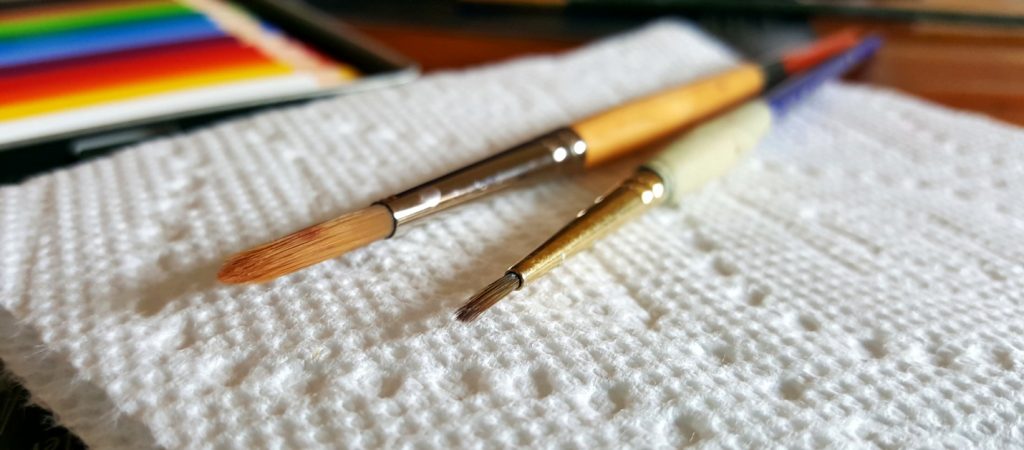
For modest watercolor pencil drawings, size 4 is my standard option, with size 2 for actually fine details.
Check a castor sizing chart to see your options. Consider how big you lot'll be working and choose a few brushes accordingly. Keep in mind that a larger castor will hold more h2o, and so beginners may want to start small.
A great pick for beginners is the Transon Round Brush Set . This ready is very reasonably priced and it includes 8 differently sized round brushes. The brushes are made from a combination of nylon and goat pilus, which means they will hold water well and brush it on smoothly.
For more versatility, consider the Princeton Elite Set , which includes a size 2 round castor for fine details, a size eight circular brush for roofing large areas, a half-inch angle shader, and 3-quarter inch wash castor. These brushes are made from synthetic Kolinsky sable, and the fine points and precipitous edges provide unparalleled detail capabilities.
For a super high quality, accurate sable watercolor brush, consider this da Vinci Watercolor Castor . It's made from Russian bluish squirrel hair which is ways it'due south a true sable brush, and it has first-class water-holding capabilities. The wood handle and copper wire wrap are sustainable and cute as well.
Optional materials
A graphite pencil can come up in handy for preliminary sketches. If yous have the choice, go with a pencil with 2B to 4B lead for sketching. This Derwent Graphic Drawing Pencil Set provides a broad range of twelve unlike black and soft leads that are great for everything from sketching to drawing in fine details. The soft (B series) pencils accept a thick 3.v mm cadre for creating soft, polish lines.
Some other great option for sketching pencils are the Staedtler Lumograph Graphite Drawing and Sketching Pencils , which include six pencils in the set. They give a total, night colour when applied and are excellent for sketching a preliminary drawing.
Masking fluid is another convenient material. You tin use this fluid to block out areas of your painting that you want to remain white or a significantly lighter color. Examples might exist clouds, the polish on a piece of fruit, or the whites of a person's eyes.This Winsor & Newton Art Masking Fluid is an first-class option since it's colorless and won't stain. Yous but paint it onto the spaces that you want to remain white, let it dry out, apply your watercolor pencils and water around it, and and so once the paint is dry you can rub off the masking fluid with your finger or a rubber eraser. It volition requite a well-baked negative space which can be otherwise very hard to achieve with watercolor media.
The only difficulty with a clear masking fluid is that it is predictably hard to see as you utilize it, so you may not be able to tell if you lot've sufficiently coated the desired area. To make it easier, you can opt for a colored masking fluid, similar this Pebeo Drawing Glue . It's tinted blue for easy visibility
Apply a cheap brush to coat those areas in masking fluid, and permit it dry. And then y'all can draw and paint without worrying about getting any color on those sections. When you're finished, rub the masking fluid gently to remove it, revealing a clean, white surface underneath.
Watercolor Pencil Techniques
Finally, let's get into some of the techniques you tin can use with watercolor pencils. While most people know you lot tin add water to a watercolor pencil drawing, at that place are actually several different ways to use this media. I'll start with the virtually mutual:
Technique 1: Draw First, Add Water Later
Almost artists use watercolor pencils to create a drawing and add together water afterward or in stages every bit they draw.
In this method, first by outlining your subject area lightly, either with a graphite pencil or the dominant colour of your bailiwick. Note whatever areas that you lot want to proceed white or very light. Yous can fifty-fifty outline the highlights.
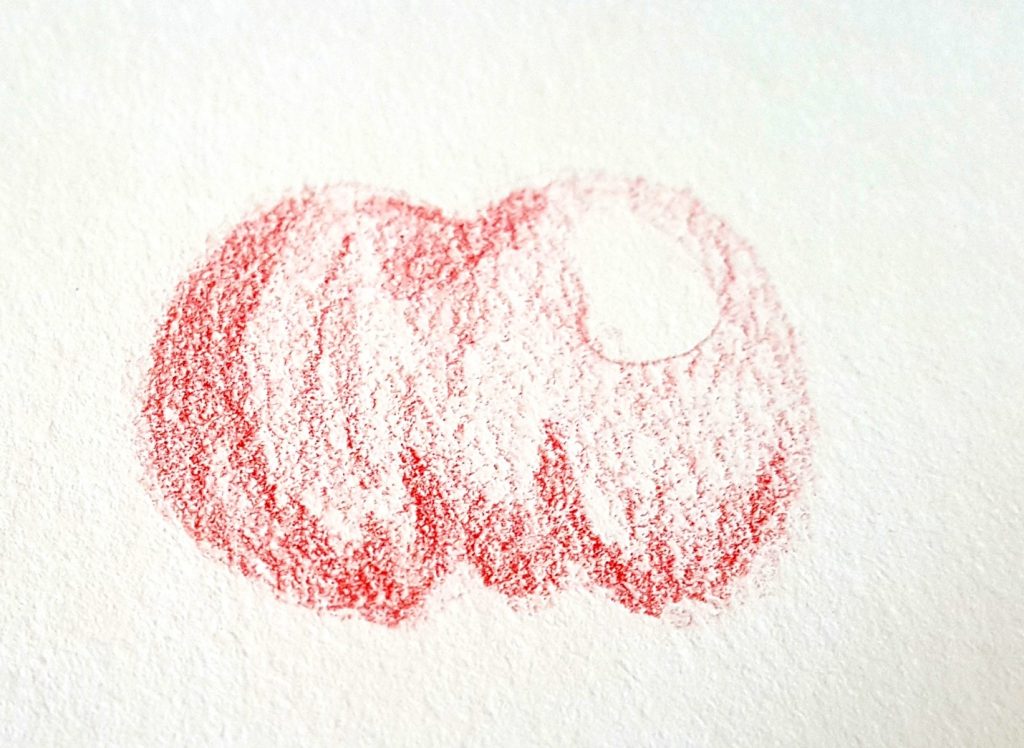
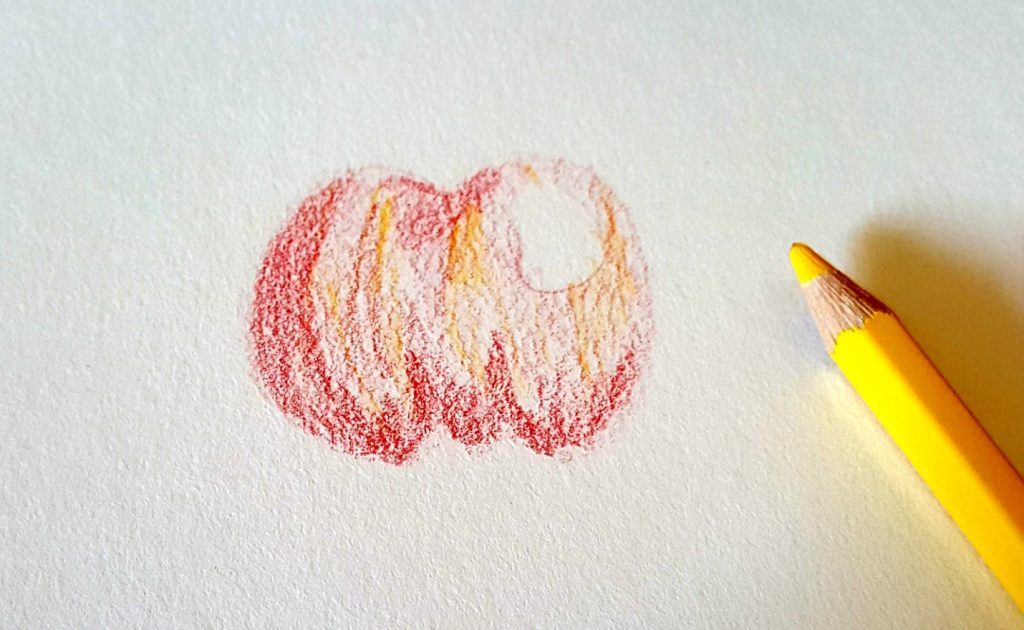
Colour in your subject lightly with the main color. Add other colors, starting from the lightest and catastrophe on the darks and shading.

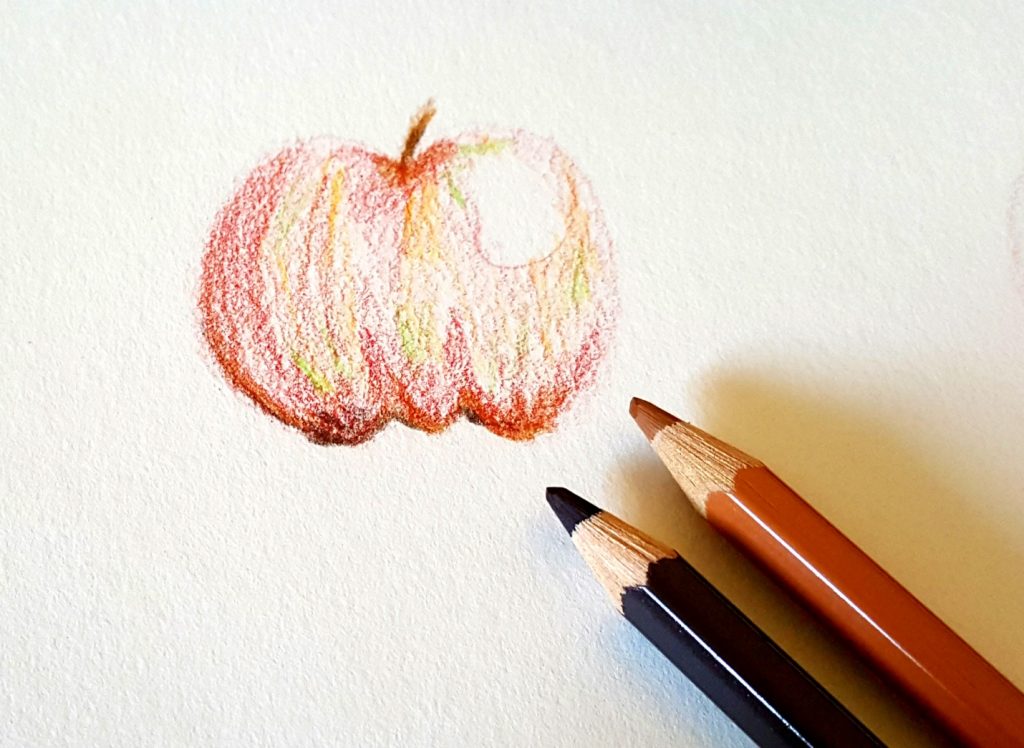
Finally, it's time to add together h2o! Moisture your brush, and dab it on a paper towel to remove excess h2o. You don't your brush to be dripping wet on the first stroke.
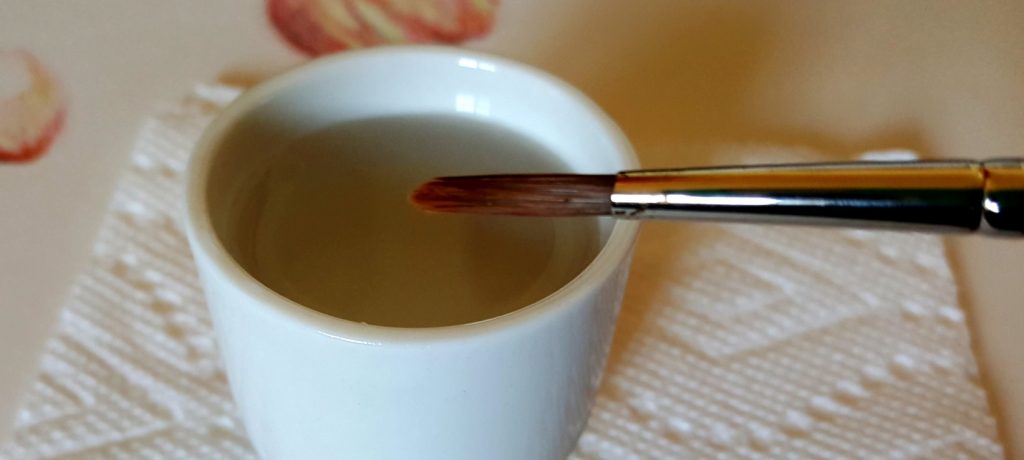
Starting with the lightest areas, begin painting h2o onto your drawing. Y'all'll notice that the pigments become much brighter afterwards you add h2o. Rinse and wipe your brush before adding water to a new color. Otherwise, you risk overpowering the new color with the one already on your brush.


In one case y'all make full in your entire field of study, yous can apply the remaining pigment on your castor to create a light ground or background.
Technique two: Dip Pencils into Water

Instead of using a brush, you can too dip your pencils directly into water. The result is a thicker, more vibrant line.
However, you'll soon realize that the water's effects don't final long. In the image higher up, you tin can encounter that the areas with blood-red and brown shading beginning off potent and and so fade into regular pencil shading.
Once yous've finished using this technique, make sure to dry your pencils with a newspaper towel to go along them in good condition.
Technique three: Describe onto Moisture Newspaper

Watercolor painters use lingo like "wet-on-wet" and "moisture-on-dry out." This technique would be dry-on-moisture.
You can wet the paper first by brushing down a light, even coat of water. Stick to the area you plan to describe on first, rather than wetting your unabridged paper. For this technique, you might find it useful to take large flat castor on hand.
Apply a dry watercolor pencil to draw on top of the wet area. You'll observe that the result is similar to dipping your pencils into h2o, but the effects last longer.
You lot'll see brighter, more intense color with a textured, grainy look. You don't have to worry nigh repeatedly dipping your pencil into h2o to go on upwards this outcome, but you'll still demand to work quickly before the paper dries.
Technique 4: Wet Pencil on Wet Paper


This wet-on-moisture technique uses even more water. Using a wet pencil on a wet surface causes the colors to run, much like the watercolor painting technique. The lines you lot describe will expect fuzzy and spread beyond the page.
Even so, different with painting, y'all'll see more pigment fragments. This technique produces a lot of texture and very bold color.
Technique 5: Add Detail to a Watercolor Painting
You tin also draw on top of an existing watercolor painting. Add details or emphasize the areas of painting. Then either leave your additions every bit is or add water for a smoother texture.
Bonus: Apply Watercolor Pencils as Portable Paints
Okay, this isn't really a technique, but one really nice benefit of watercolor pencils is that you can use them as on-the-get paints.
Pencil sets are meaty and easy to carry. Much more and then than paint sets. Just create your desired colors on the page first and mix in water to get your paint effects.



Source: https://www.incredibleart.com/watercolor-pencils-guide/
Posted by: eppsreck1993.blogspot.com
0 Response to "How To Draw Water With Colored Pencils"
Post a Comment