

What Types Of Lithosphere Makeup Tectonic Plates
The lithosphere is the solid, outer part of the Earth. The lithosphere includes the breakable upper portion of the curtain and the chaff, the outermost layers of Earth'due south structure. Information technology is bounded by the temper above and the asthenosphere (another part of the upper mantle) below. Although the rocks of the lithosphere are nonetheless considered elastic, they are not viscous. The asthenosphereis glutinous, and the lithosphere-asthenosphere purlieus (LAB) is the signal where geologists and rheologists—scientists who report the catamenia of matter—marking the difference in ductility between the two layers of the upper mantle. Ductility measures a solid material's ability to deform or stretch under stress. The lithosphere is far less ductile than the asthenosphere. There are two types of lithosphere: oceanic lithosphere and continental lithosphere. Oceanic lithosphere is associated with oceanic chaff, and is slightly denser than continental lithosphere. Plate Tectonics The almost well-known feature associated with World's lithosphere is tectonic activeness. Tectonic activity describes the interaction of the huge slabs of lithosphere called tectonic plates. The lithosphere is divided into tectonic plates including the North American, Caribbean area, South American, Scotia, Antarctic, Eurasian, Arabian, African, Indian, Philippine, Australian, Pacific, Juan de Fuca, Cocos, and Nazca. Most tectonic activity takes place at the boundaries of these plates, where they may collide, tear apart, or slide against each other. The move of tectonic plates is fabricated possible by thermal energy (rut) from the mantle part of the lithosphere. Thermal energy makes the rocks of the lithosphere more rubberband. Tectonic activity is responsible for some of Earth's most dramatic geologic events: earthquakes, volcanoes, orogeny (mount-building), and deep ocean trenches tin can all be formed by tectonic activity in the lithosphere. Tectonic activity can shape the lithosphere itself: Both oceanic and continental lithospheres are thinnest at rift valleys and bounding main ridges, where tectonic plates are shifting apart from ane some other. How the Lithosphere Interacts with Other Spheres The cool, breakable lithosphere is simply one of five groovy "spheres" that shape the environs of Earth. The other spheres are the biosphere (World's living things); the cryosphere (Earth's frozen regions, including both water ice and frozen soil); the hydrosphere (Globe's liquid water); and the atmosphere (the air surrounding our planet). These spheres interact to influence such diverse elements as ocean salinity, biodiversity, and landscape. For example, the pedosphere is part of the lithosphere made of soil and dirt. The pedosphere is created by the interaction of the lithosphere, temper, cryosphere, hydrosphere, and biosphere. Enormous, hard rocks of the lithosphere may be footing down to pulverization by the powerful movement of a glacier (cyrosphere). Weathering and erosion caused by current of air (atmosphere) or rain (hydrosphere) may also article of clothing down rocks in the lithosphere. The organic components of the biosphere, including plant and animate being remains, mix with these eroded rocks to create fertile soil—the pedosphere. The lithosphere also interacts with the atmosphere, hydrosphere, and cryosphere to influence temperature differences on Globe. Tall mountains, for case, ofttimes have dramatically lower temperatures than valleys or hills. The mountain range of the lithosphere is interacting with the lower air pressure level of the temper and the snowy precipitation of the hydrosphere to create a cool or fifty-fifty icy climate zone. A region'south climate zone, in plough, influences adaptations necessary for organisms of the region'south biosphere.
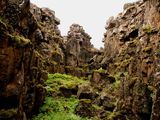
The rocky lithosphere includes part of the upper mantle and crust.
Photograph by Jennifer Plourde, MyShot
Extraterrestrial Lithospheres
All terrestrial planets have lithospheres. The lithospheres of Mercury, Venus, and Mars are much thicker and more than rigid than World's.
The LAB
The depth of the lithosphere-asthenosphere boundary (LAB) is a hot topic among geologists and rheologists. These scientists study the upper mantle's viscosity, temperature, and grain size of its rocks and minerals. What they have found varies widely, from a thinner, crust-deep purlieus at ocean ridges to thick, 200-kilometer (124-mile) boundary below cratons, the oldest and most stable parts of continental lithosphere.
Noun
a modification of an organism or its parts that makes it more fit for existence. An adaptation is passed from generation to generation.
air pressure
Noun
force pressed on an object by air or temper.
asthenosphere
Noun
layer in Globe'south mantle betwixt the lithosphere (above) and the upper mantle (below).
Substantive
layers of gases surrounding a planet or other celestial body.
Noun
all the different kinds of living organisms within a given area.
Noun
part of the World where life exists.
brittle
Adjective
delicate or hands broken.
climate zone
Noun
area separated from others by its long-term weather patterns.
continental crust
Noun
thick layer of Earth that sits beneath continents.
convection
Noun
transfer of heat by the motility of the heated parts of a liquid or gas.
Noun
rocky outermost layer of Earth or other planet.
cryosphere
Noun
icy role of the Earth'south waterincluding icebergs, glaciers, and water ice caps.
dense
Adjective
having parts or molecules that are packed closely together.
diverse
Adjective
varied or having many unlike types.
ductility
Noun
ability of a solid fabric to withstand stress or force by changing course instead of breaking.
Noun
our planet, the third from the Sun. The Earth is the but identify in the known universe that supports life.
earthquake
Noun
the sudden shaking of World'south chaff caused by the release of energy forth fault lines or from volcanic activeness.
elastic
Adjective
able to bend easily.
environment
Noun
conditions that surround and influence an organism or community.
Noun
human action in which earth is worn abroad, often by water, wind, or ice.
fertile
Adjective
able to produce crops or sustain agronomics.
geologic
Adjective
having to exercise with the physical formations of the World.
geologist
Noun
person who studies the physical formations of the Earth.
Noun
mass of water ice that moves slowly over land.
Noun
land that rises higher up its surroundings and has a rounded tiptop, unremarkably less than 300 meters (1,000 feet).
Noun
all the Earth's h2o in the ground, on the surface, and in the air.
Noun
the geographic features of a region.
Noun
outer, solid portion of the Earth. Also called the geosphere.
lithosphere-asthenosphere boundary (LAB)
Noun
chemical and mechanical distinction between the cool, rigid lithosphere and the warmer, more ductile asthenosphere.
Substantive
middle layer of the Earth, made of mostly solid stone.
mid-ocean ridge
Substantive
underwater mount range.
mountain
Noun
landmass that forms as tectonic plates interact with each other.
oceanic chaff
Noun
sparse layer of the Earth that sits beneath ocean basins.
Noun
a long, deep low in the ocean floor.
organic
Adjective
composed of living or once-living material.
orogeny
Substantive
the way mountains are formed.
pedosphere
Noun
layer of Earth consisting of soil and all it contains (such every bit water, air, organisms).
plastic
Substantive
chemical material that tin can be hands shaped when heated to a high temperature.
Substantive
all forms in which water falls to Globe from the atmosphere.
Substantive
all forms in which water falls to Globe from the atmosphere.
Noun
liquid precipitation.
remains
Substantive
materials left from a expressionless or absent organism.
rheologist
Substantive
scientist who studies the flow and shape-changing (deformation) of matter.
Noun
depression in the basis caused by the Globe'southward crust spreading apart.
rock
Noun
natural substance composed of solid mineral matter.
snowfall
Substantive
atmospheric precipitation fabricated of ice crystals.
soil
Noun
tiptop layer of the Earth'due south surface where plants can abound.
stress
Verb
to strain or put pressure on.
tectonic activity
Substantive
movement of tectonic plates resulting in geologic activity such as volcanic eruptions and earthquakes.
tectonic plate
Noun
massive slab of solid stone made up of World's lithosphere (crust and upper mantle). Also called lithospheric plate.
Substantive
degree of hotness or coldness measured by a thermometer with a numerical scale.
thermal energy
Substantive
heat, measured in joules or calories.
valley
Substantive
low in the Earth between hills.
viscous
Describing word
liquid that is thick and sticky.
Noun
an opening in the Globe'southward crust, through which lava, ash, and gases erupt, and also the cone built by eruptions.
Noun
the breaking down or dissolving of the World's surface rocks and minerals.
Noun
movement of air (from a high pressure zone to a low pressure zone) caused by the uneven heating of the World past the dominicus.

What Types Of Lithosphere Makeup Tectonic Plates,
Source: https://www.nationalgeographic.org/encyclopedia/lithosphere/
Posted by: eppsreck1993.blogspot.com
0 Response to "What Types Of Lithosphere Makeup Tectonic Plates"
Post a Comment