

How To Draw A Map Malcolm Swanston
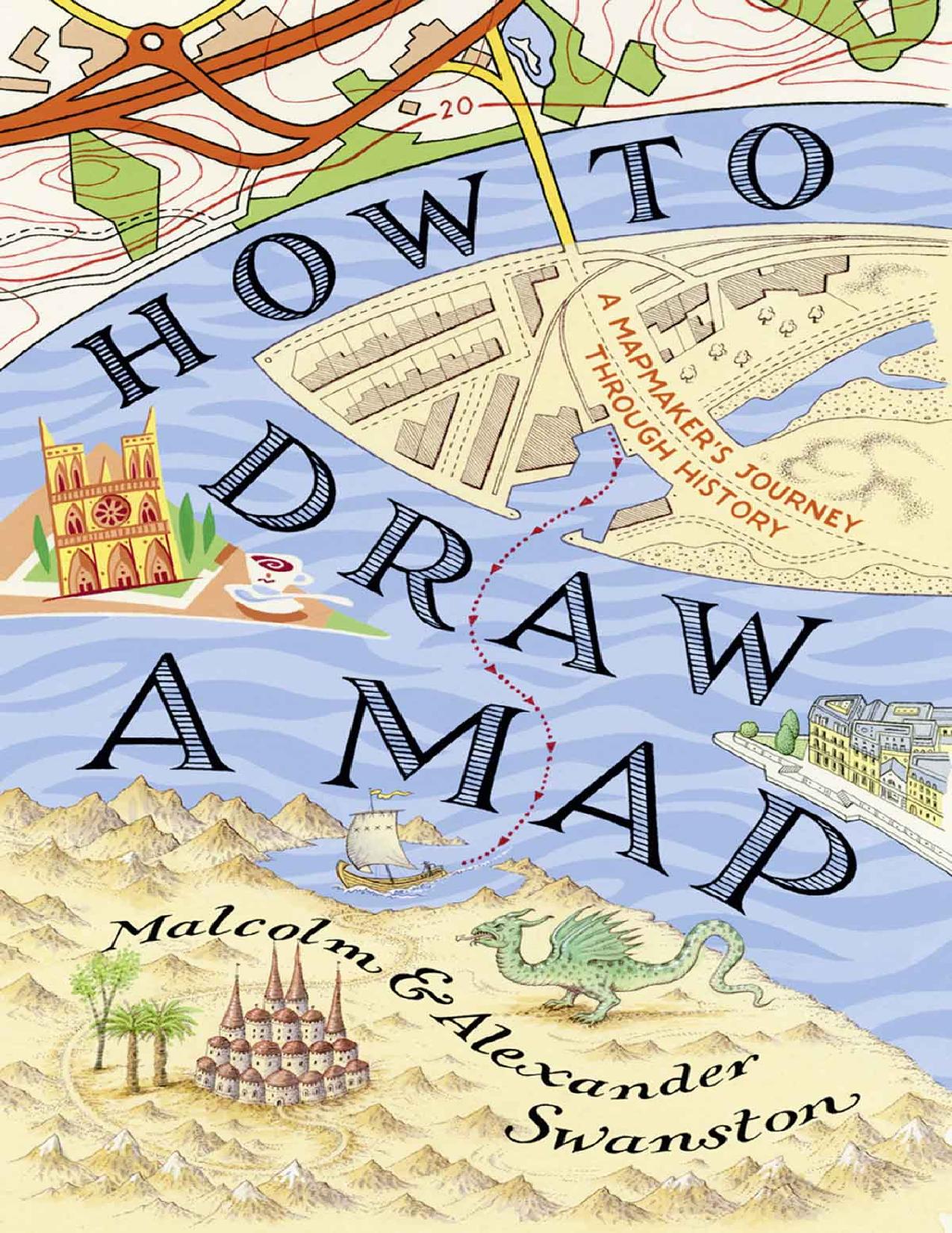
Author:Malcolm Swanston
Language: eng
Format: epub
Publisher: HarperCollins Publishers
Published: 2019-08-13T16:00:00+00:00
What could a chap do? Dampier went back to the life of a privateer and on one of his later voyages he rescued Alexander Selkirk, whose story is said to have inspired Daniel Defoe's Robinson Crusoe. He died in London in March 1715, £2,000 in debt – into each life a little rain must fall …
JAMES COOK
James Cook, navigator, explorer, gifted cartographer and fellow of the Royal Society, was born on 7 November 1728 in Marton, Yorkshire.* After just five years of formal education he began work locally, helping his father, who was a farmer. By the age of 16 he had moved to Staiths as an apprentice haberdasher, but the work did not suit young James, who seems to have spent his time looking out of the window at the waves of the grey North Sea. His employer, perhaps despairing of his inattentive apprentice, introduced him to Captain John Walker of Whitby, a port just down the coast. John Walker and his brother Henry were well-known ship owners in the coal trade, plying between northeast England and London. James was offered and accepted a merchant navy apprenticeship and his first ship was a collier (coal carrier), called the Freelove. On this and other ships in the coastal trade he applied himself to mathematics, astronomy and the finer arts of navigation. After his three-year apprenticeship, he worked in the Baltic trade and by 1755 was offered his first command, the Friendship. Just one month later, however, on 17 June 1755, he joined the Royal Navy.
Cook rose steadily through the ranks and in June 1757 passed his master's examination, qualifying him to handle a ship of the King's Navy. He joined the frigate HMS Solebay as sailing master on 30 June 1757 under Captain Robert Craig.
He served throughout the Seven Years' War in North America and during his service there, his skill at navigation and cartography was increasingly appreciated. He mapped the St Lawrence River, allowing General Wolfe to plan the attack on Quebec in 1759.
For five years, he mapped Newfoundland and adjacent coastlines, producing the first large-scale hydrographic surveys using triangulation† to establish accurate land outlines. Cook was capable and ambitious, stating that he intended to go not only 'farther than any man has ever been before me, but as far as I think it possible for any man to go'.
Cook had his chance in 1768; on 26 May the Admiralty commissioned Cook to take command of a scientific expedition to the Pacific Ocean to observe the passage of Venus across the sun. It was hoped that the information he recorded, when added to observations taken at other locations around the globe, would establish the earth's distance from the sun. He was promoted to lieutenant in order to take command and the Royal Society also granted Cook 100 guineas (£110) in addition to his naval salary. At 39 years old, things were looking up.
On 26 August 1768 he set sail on HMS Endeavour, a sturdy vessel built in Whitby, Yorkshire, as the Earl of Pembroke, the kind of ship Cook was familiar with and well understood.
Download
Copyright Disclaimer:
This site does not store any files on its server. We only index and link to content provided by other sites. Please contact the content providers to delete copyright contents if any and email us, we'll remove relevant links or contents immediately.
How To Draw A Map Malcolm Swanston
Source: https://ebook-hunter.org/how-to-draw-a-map-by-malcolm-swanston_5d765d482533b9398a79d9bb/
Posted by: eppsreck1993.blogspot.com
0 Response to "How To Draw A Map Malcolm Swanston"
Post a Comment